


A person works on recovering from an injury with their own style: submerged in a frozen lake while drinking bourbon.
Hiring a personal trainer often comes with some degree of uncertainty about what to expect.
It isn’t just trying to figure out if the trainer you’re hiring has the skills to help you achieve your goals, it’s also about whether they’re good enough to teach you the things you didn’t even know should be goals.
shouldn’t just be about having someone to put you through a workout and then once you’re good and tired, send you on your way. You should expect your trainer to understand you personally, where you’re currently at, what your capabilities are, and any limitations you currently have. They should be able to program personalized workouts, designed for your current capabilities, while simultaneously increasing your progress.
should be able to address your pain and mobility issues, and work to resolve any problems you might have through skillful problem-solving and an awareness of the unique demands, activities, and challenges of your lifestyle.
They should be able to explain with clarity why the exercises you’re doing are beneficial, as well as be able to give clear instruction on how to properly perform all of your exercises.
They should understand the multitude of different approaches that can be applied to resolve chronic pain issues or issues arising from injuries or surgeries. They should be able to correct muscle imbalances, and be aware of the correlation between weak muscles and tight muscles, and not only be able to recognize what the problem is, but know the proper course of action to take to resolve it.
Putting you through a workout and building strength is just one skill in a wide range of skills that a modern day trainer of the future should possess. If you’d like to read more about what to expect from your personal trainer, check out our blog post, Finding the Best Personal Trainer.
We value inclusion, compassion, and a sense of community. We strive to build everyone up and to support one another through a welcoming, open-minded environment. We are LGBTQ+ friendly.
For a long time I have searched for a better descriptive word or phrase for what I do other than ‘Personal Trainer’. When someone asks what I do and I tell them, “I have a personal training business”, the reactions and responses are almost like clockwork. Most of the time someone will respond with a self deprecating comment about how they need to get back in the gym and lose some weight. Other times they reply with a story about a personal trainer they had and, I hate to say, most of those stories are not about positive experiences.
Here’s the thing though: I totally get it. I started working for a company called Beachbody about 16 years ago. They make exercise videos for various types of workouts. The last time I checked, their most popular one was the P90X series, but the Insanity workouts were also quite popular. I even worked on their last installment, P90X3, and am in one of their videos. For the fitness world it was an interesting place to work. We all know about workout fads that come and go, and are interested in hearing about the “next big thing” in fitness. Working at Beachbody was interesting because they were the ones coming up with and then pushing the “next big thing”. It never hurts to be the guy selling soap when you’re telling people how important it is to wash your hands.
I suppose the appeal was having exercise videos where anyone could watch and workout with a “personal trainer”. They tell you what to do, for how long, and that you can’t stop until they say it’s over. They say things like, “no pain, no gain”, and “pain is just weakness leaving the body”. Nobody ever accused them of being wordsmiths.
In the beginning of my career I was definitely a “personal trainer”. My job was to push you through a workout, make you sweat, possibly hate me, and then send you on your way, tired and sore. When you start working at a gym, that’s just what you do, they’re not really training you to be a better trainer, they’re training you to be a better sales person. It’s not about how good you are, it’s about how much training you can sell. And there are a lot of catchy phrases and slogans that can sound good if you frame them in the right way at the right moment in the conversation to make it seem like you really know what you’re talking about.
But here’s the thing. Like with any job, it takes time, dedication, and effort to increase your scope of knowledge and abilities and become better at what you do. But as I worked through the fitness world though, I found that this desire and effort to get better and learn more was typically the exception to the rule rather than the industry standard. And thus began my dissatisfaction with the broad, vague, and somewhat polarizing term, “personal trainer”.
Like I said, for a long time I’ve tried to come up with a better term for what it is I do.
Exercise specialist. Pain resolution practitioner. Fitness coach. Human Movement Expert. Health Advisor. Therapist. I’m kidding about the last one, but also kinda not. A pretty decent amount of talk therapy goes on during any given training session. I think it just has to do with being a good listener, myself.
But none of these really give a better understanding of what I do, but I guess that’s also because an association is generally built into a word or phrase, and for better or worse, “personal trainer” was a recognizable term. Even if what it conjured up for most people wasn’t accurate at all for what I do. So you see my dilemma.
It turns out that just pushing someone through a workout so they feel tired and sore and “like they worked out”, generally isn’t a very good approach to exercise. I fully understand that for some people, that’s all they want, but that definitely should not be the job you hire a personal trainer for.
The first thing I would say that makes a good personal trainer is someone who does not have a “one size fits all” approach. While there are certain fundamental exercises that pretty much everyone should be able to do, a good personal trainer understands that they have to figure out where each individual client is at, what their current capabilities are, where they are lacking or what limitations they have, and be able to build a program for that specific person with those things in mind. If you just push someone through a workout that they can’t handle, more than likely they’re just going to get hurt, and then they might not be able to workout at all.
Equally important is a trainer who knows what they are doing. I can’t stress this enough. There are a ton of catchy phrases and idioms and whatever else out there, but if your trainer is telling you something and it doesn’t make sense and they can’t explain it to you so it makes total sense, it is highly likely this is not a good trainer. The fundamentals of movement and exercise and lifting are all based in physics. This basically breaks down into your ability to move yourself (and probably a weight) through space while maintaining your balance, stability, and control. Understanding this and being able to explain to someone how to position themselves in relation to gravity for optimal leverage and control is fundamental. It’s math. There’s no secret to it.
A good trainer can explain pretty much everything in down to earth terms. They should be able to explain why the exercises they’re having you do are important for you, what affect it’s creating for your body and why that’s positive, and if you have a question and they don’t know the answer, they should openly tell you, “I don’t know”. And probably follow it up with, “I’ll read up on it”, or something to that effect. But no one knows everything. No one should expect someone to know everything. And no one should be dishonest about not knowing something.
Another key thing that I would say makes a really good personal trainer is one that is a problem solver. Everyone has different lifestyles, hobbies, jobs, and reasons for why their bodies move the way they do. This means that there are particular reasons for why you might have pain or discomfort where you do, or why certain exercises or movements are hard for you. And a good personal trainer should have the ability to assess all of those things in order to figure out what might be causing your problem. Sometimes it’s not an easy fix, or there are multiple factors converging to create an issue, therefore you want someone who is good at problem solving in order to come up with pragmatic and actionable solutions. As anyone with a body knows, aches and pains are just a given. And they are also often a huge barrier to being able to exercise or be active in general. One of my certifications is “Corrective Exercise Specialist”, and while this is a very helpful tool in addressing joint and muscle pain issues for clients, being able to recognize the intricacies of an individual’s lifestyle to find root causes for each problem is really where a good personal trainer is most effective.
Lastly, I would say a good personal trainer is one who educates you. While some people might like the accountability of having a personal trainer, or prefer to have someone program their workouts for them so they don’t have to, your trainer should still be teaching you about proper form, lifting mechanics, and effective program design for the day their client wants to spread their wings and fly. This really should be the main goal of every good personal trainer. Teaching you how to do it on your own.
There are certainly many other factors that make a personal trainer good. Being able to listen to their clients concerns, having empathy, and probably being enjoyable to be around are a few others. An hour can feel pretty long if you don’t like the company of the person you’re spending it with. But that’s also relative. You’re not going to be everyone’s cup of tea. But as a personal trainer, if being a good listener and having empathy is just them being themselves, that’s really what most people are looking for.
While I wasn’t able to come up with a better term to describe what I do, hopefully this post will give you some insight into what a good personal trainer should be able to do, and what you should be able to expect from your personal trainer. Feel free to ask a question or drop a comment! And if you’re looking for personal training in the Austin, Cedar Park, Pflugerville, or Leander area, send us an email and set up your consultation and movement assessment with Foundation Personalized Fitness!
A lot of times we get caught up in new diets and exercises, or fads that claim to be the next game changer. But the fact is, when it comes to human movement and the related pain and injury issues, we are still learning a lot about the human body; how it functions and why it reacts in the ways that it does. I’m not the first person to say that our healthcare system is predominantly treatment based rather than prevention based. But honestly a lot of that comes from a lack of knowledge and understanding about the human body.
Quite a few people are still surprised when they find out that the majority of the time when they’re experiencing joint pain, the cause is generally too much tension in one or more of the muscles that attach to that joint and make it move. One solution is to stretch or foam roll the muscles in that area, or even just get a deep tissue massage. This is becoming common knowledge for more and more people, but the information is still not as widely known as it should be.
For a lot of us, simplifying our workouts and knowing what to do is one of our main objectives. It saves time, creates consistency, and provides a measurement to gauge improvement and progress. Fortunately, there are really only three main functions: push, pull, and stabilize (most people are referring to this when they say they need to work on their core). You can break it down a little bit more by separating it into upper body push and pull, and lower body push and pull. And there are a multitude of exercises that meet these basic needs, so that can provide some variety, but unless you have a specific skill or talent you’re working on, there’s no need to make things any fancier than that. Admittedly I am glossing over stability, balance, and agility training, but that’s simply because those are topics unto themselves. Although, the following exercises will increase your core strength and therefore your stability.
This list is by no means meant to be exhaustive, nor is it a guide on how to construct a workout, it is simply my suggestions on the top 5 exercises people should be doing, as long as they are able to. So without further ado:
Whether it’s back squat, front squat, hexbar squats, goblet squats, or simply bodyweight squats, this exercise should be a priority in your workouts. No matter which version you’re doing this exercise builds hip and leg strength as well as building core strength and endurance. By adding weight to this exercise it creates a demand on your ability to control the movement and focus your mental energy on how you’re moving and stabilizing the weight. Additionally, this is considered a complex movement, so your ability to execute it properly demonstrates a higher level of coordination and skill.
This is another full body exercise, with the demand being primarily on your posterior (back) side. And again you have options, ranging from traditional barbell deadlift, to sumo deadlift, hexbar deadlift as well as using dumbbells or kettlebells. This exercise will build glute strength, along with hamstrings, hips, and back (particularly lats and low back). Once you’ve mastered the basic mechanic of the movement, the hip hinge, it’s relatively straightforward and not overly complicated. This will allow you to steadily increase the weight you can move thereby increasing your strength rather quickly.
It’s possible that this one might ruffle some feathers, and some of you might not even know what it is. But in my opinion, when you’re trying to prioritize exercises that put demand on your whole body to maximize your efforts and get the most results, overhead press is superior to bench press when it comes to upper body. I’m also referring to a strict overhead press with either a barbell or dumbbells. You engage your hips and core to stabilize your body from your midsection down to your feet, and then you press the weight overhead into a stabilized position before lowering it back down. This exercise works your shoulders, arms, back, upper chest, and if you’re doing it correctly, your core. There’s no bouncing or creating momentum in order to get the movement started. This exercise is much closer to how we move as humans than a bench press since typically we need to stabilize ourselves when we move, and even more importantly, when we move a weight. As Mark Rippetoe notes about the bench press in his book Starting Strength, “it is an unusual thing… to actually place the back against an immovable object and use it to push against something else.” If you’re interested, he makes a very compelling and sound argument that even when an athletic movement involves strength through the upper body, the transmission of that force follows a kinetic chain that starts at the ground, with the feet planted into the ground. His chapter on overhead press was one of my favorite chapters in his book. Overhead press is a powerful upper body movement, while still majorly incorporating a demand on your core and lower body in order to properly execute it.
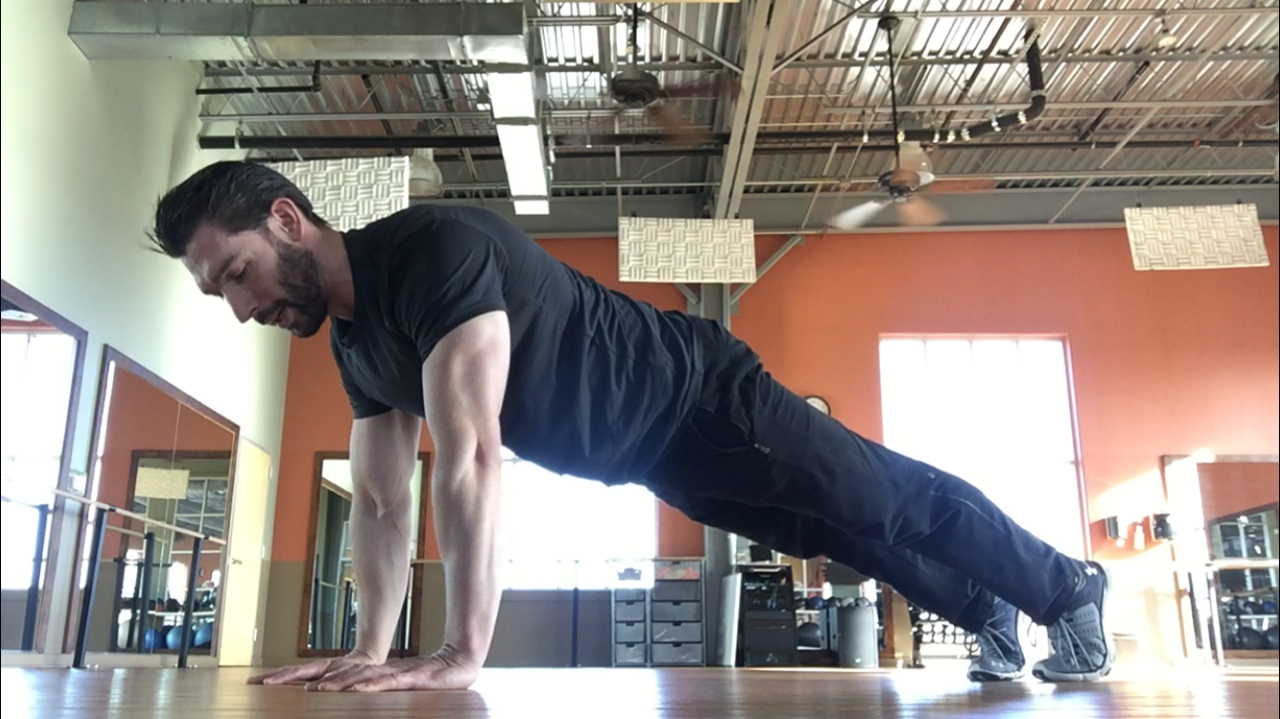
I’m rounding this out with two of the best upper body exercises that almost no one wants to do: push-ups and pull-ups. Both of these exercises build strength in the arms, back, chest, shoulders, and a multitude of core muscles. Not to mention being outstanding strength endurance exercises. In fact, if you had no equipment but could do push-ups, pull-ups, and running drills (think distance, sprints, hills, stairs) you might not get huge, but you would be one strong human. Therefore, I consider push-ups and pull-ups fundamental to any workout routine.
While I promised simplicity, I also want to point out the options for variety as well. Every one of these exercises can be modified and altered. If you feel like you need more balance and stability, or if you notice a strength imbalance between one leg over the other, you can modify squats and deadlifts to be done single leg. This will increase your balance and stability and also ensure symmetrical strength. For both upper and lower body you can change tempo or add pauses. For example, when doing a push-up, lower yourself down to the bottom position on a slow three second count and then hold the bottom position for another three seconds before returning to the top. These concepts can be applied to any one of these exercises. But probably the most important thing is getting to know your body, and recognizing when and how you need to make changes based on the feedback you’re getting. Don’t ignore muscle imbalances or pain. Do a little bit of research and some body work and address the issue. Exercise, similar to most nutrition, does not have to be complicated and confusing. There are fundamentals to each that can be a tremendous benefit to learn while you’re on the path to connecting with your body more, by both challenging it and taking care of it.
Thanks for reading! Please reach out with any questions!