Training for a SuperHalfs Marathon
Training and preparation for any race or event doesn’t need to be overwhelming. But understanding the demands as well as your current skill level is the key to success.
I honestly never intended to run a half marathon. I did a Tough Mudder style event back in my hometown called ‘The Viking Run’, which I did absolutely zero preparation for other than my usual weekly workouts, and while I was glad I did it I was even more glad when it was over.
I had done a handful of 5Ks, but those were more community oriented to get people out and about and bring them together for fun. Walking a 5K is as common as running one.
I remember years ago when my sister was training for the Boston Marathon and I basically thought she had lost her mind.
No, a combination of boxing and casual running were what I added to my strength training routine for cardio, and that was fine with me. And then I started dating a runner.
Spoiler alert: it didn’t work out, but that story is for another day. Plus that story sucks and I’ll probably never really get over it. But how it started was that for her 40th birthday she wanted to go to Portugal and run a half marathon in Lisbon. Every year there are these half marathons around Europe called SuperHalfs, and she had signed up for the one in Portugal with a friend of hers and invited me. All her other friends wanted to go to Cancun or some other party destination, but she was a runner, and she had her heart set on celebrating her 40th in Portugal running a half marathon. It would be dishonest of me to not admit that that part of her personality was one of the things I loved about her the most.
Beforehand I didn’t think much of it, but I’ll never forget how cool I thought it was that they shut down half the city so thousands and thousands of people could run through the streets. The race started on this bridge, and I know shutting that down was no easy feat. How do I know? Because the locals have no qualms telling you all about it. And how annoying it is 😂

I met her at the finish line with a bag of Lisbon’s famous custard pastries and a bottle of Johnny Walker Red (they don’t have a great selection of whiskey in Portugal). I remember telling her how impressed I was and that I’d have to train like a madman to ever do something like that. And it just kind of dug in there at the back of my mind. A challenge. Something I would have to work hard for, to commit to, something I would only be able to do if I trained and prepared for it.
Now, there might be some people reading this right now thinking, easy buddy, it’s a half marathon, you’re not going to the Olympics.
Sometimes when my clients admit to me that they feel uncomfortable going to the gym because they feel like people are judging them for not being as advanced or in shape as other people at the gym, I like to tell them this: anyone who would ridicule you for working hard to get better at whatever stage you’re currently at isn’t worth a second thought. No real athlete looks down on anyone who’s putting in the work.
And that’s all I have to say about that.
At the time my run was usually about a mile, maybe a mile and a half, and I most definitely took breaks and walked for a couple of minutes here and there. It’s actually pretty astonishing how easy it is to lose your cardiovascular endurance as you get older if you don’t maintain it. I started playing soccer when I was around 9 or 10 and played all the way through to college, so running for what seemed like forever was just a normal part of my life for over a decade. And then I stopped for almost two decades, and the result was pretty unsettling. I would basically be starting from scratch.
The biggest obstacle is probably that I live in Texas, and the climate here is not exactly a runner’s friend. It does offer one advantage though: if you train for a half marathon in Texas when the race is going to be somewhere else with a nice climate, you’re going to feel about 100% better when you’re in the race than you would have thought.
How It Stated
We came back from Lisbon in March. Before it got too hot I would join her for a run now and then where she would indulge me by stopping to walk frequently, but also encouraged me to SLOW DOWN. Part of my problem was that I wasn’t paying attention to my pace, so the reason I would be dying after less than a mile was because I was trying to haul ass. When I matched her pace, the pace she thought I should be aiming for, I was pleasantly surprised that I could hit two miles before I wanted to collapse. At this point though it was just for fun and a way for us to do something together that she loved. I wasn’t training for anything. And by the time summer hit and the temp went nuclear, I was waning in my effort toward this new running adventure. I needed a goal.
As fall came and the weather cooled I gradually picked it back up again and we would go together a few times a month. At this rate I wasn’t seeing any major improvements other than the runs I was doing started to get easier. And I really want to make a point about that, at least for what my experience was, as someone basically starting from scratch: for a pretty good while in the beginning, maybe even the first year, there really didn’t seem to be any measurable results. The biggest results I was seeing, for a substantial amount of time, was simply that what I was already doing started to get easier. And for me that was really something I had to be okay with. I was used to weight increasing on my lift, or rep count increasing, something measurable. For this the only result was that it got a little easier. And that’s a tough mindset to get into if you’re someone who likes measurable results.
Typically, running in the winter in Texas wasn’t that bad if you don’t mind the cold, and it never really gets that cold here. But that winter was a bad one. We had ice storms and power outages and the temps were frigid for much longer than what is considered normal. So it wasn’t really until the spring that we got back into any running routine together. The big factor this time though was that it was coming up on the one year anniversary of her Superhalf in Lisbon. And as we started running again I could still feel the endurance I had gained over the last year and I had the urge to start pushing more.
That spring we went to her friend’s wedding in North Carolina and decided to extend our stay for a little vacation of our own, so we rented an Airbnb in Asheville for the week after the wedding. It was a small house on this huge, rolling property that we could wander around and explore. Hiking trails, hills, and a big river running through the property. So naturally (sarcasm) we added some runs in during our vacation, at one point even doing hill sprints until I thought I was going to puke. I forgot to mention that at this point we had gotten engaged. And we had also started doing some casual research on the upcoming races for next spring. It started off as kind of a joke, like, wouldn’t it be fun? Until we had “joked” about it so much that the idea had morphed into more of a, how can we make this happen? Not unlike our engagement.
Our training became more organized and disciplined. We started a schedule of when we would run, and a goal for the distance of that run. We could no longer limit ourselves to running together and had to pepper in individual runs when our schedule allowed. Progress at this point became incremental but measurable. I had spent the last year casually building up my endurance, but now that I had a goal and was planning my runs regularly the results became measurable. I could start challenging myself to hit a set distance of miles or time. I began to recognize that not every run had to be all out, and in fact it worked better to offset each challenging run with a moderate run that wasn’t difficult to do. This is also when I learned the importance of water for long distances and a thing called, Gu, which are electrolyte energy chews. And as summer came around again we both discovered an amazing device called a Kool Tie, which is like a short, small scarf filled with these weird crystals that absorb water and expand and don’t dehydrate for days, so you wear this dripping wet handkerchief around your neck to help keep you cool so you don’t die in the Texas heat.
At this point we had pretty much committed to doing this and threw caution to the wind. Was there a race still open? Probably. Was it going to be expensive? Oh, for sure. But had we worked hard and trained and deserved to see what our hard work looked like? I said hell yes, and she said, meh… And this is where I had to play my hand, and say, hey, I know you’ve run a lot of these, and full marathons, but I’ve never done this and it’s really important to me.
Was this a little manipulative? I mean, you know. Do I regret it? Not even a little.
The problem now became that it looked like all the races had sold their slots. There are six Superhalfs every year across Europe, and you really needed to buy your race slot in advance. My disappointment grew as it looked more and more like there weren’t any races left open. We originally wanted to go back to Lisbon but that had sold out almost immediately. Our last hope had been that the race in Prague seemed to have hit a snag. It wasn’t showing as available but it also didn’t say there were no slots left like the others. It was odd but our only hope. I would check every day to see if tickets were available, and I’ll never forget the day I checked the website and out of the blue it said that race tickets had finally become available. I didn't even hesitate. I think I was one of the first 300 people to sign up for that race. I even got the early sign up price, 111 Euros for both of us. This shit was on.
Now that we had signed up for an actual race it was time to prioritize training if I wanted to actually run the race. By this point I had gotten used to setting up a schedule, but it had just ticked over to September. We were coming out of the summer, and while having ways to keep ourselves a little cooler and hydrated were helpful, I had still found it impossible to condition myself to run 13 miles in that heat. I think so far I had maxed out at 5 or 6 miles. And if you’re thinking right now, “it took you over a year to go from 2 miles to 6 miles?” Yes, that’s realistically how long it can take to condition yourself at that point when you’re starting from scratch and trying to get there through Texas summers. Fortunately for us, the path ahead was through fall, winter, and spring, with the race being in the first week of April. So if I wasn’t able to complete the race or had to walk some of it, that would be entirely on me.
I discovered a lot of things along the way toward training for a half marathon. My fiancee's certifications in MSS (Muscle Systems Specialist) is what kept both of us out of pain and injury. We were putting our bodies through a lot at this point, and all that wear and tear can slow you down. If I had to try and explain MSS to someone, it’s like the opposite of self myofascial release. If you’re familiar with a foam roller you probably get the idea of self myofascial release. You have a muscle or group of muscles that’s tight because it’s over worked, so you use a foam roller or a ball or something like that to break up the tension in the tight muscles to reduce the pain. The idea behind MSS theory is that you have a tight, overactive muscle for a reason, which is that some other muscle or group of muscles has shut down and isn’t performing optimally. That’s why the other muscle had to take over and is now tight and painful from overworking. So what they do is run a series of muscle tests to see which muscles have shut down, and once they identify the muscle or muscles that are shut down they perform specific types of activations to get them back online. And the theory is that once you get these muscles properly functioning again, the overactive muscle can almost immediately get relief since it no longer has to do so much work. As complicated as it may seem, I give it total credit for keeping me in the game and able to max out my training in preparation for this race. Sometimes it wouldn’t be until the next day that I felt better, but it worked every time.
As the weather cooled at the same time as our endurance improved, it made it so much easier to push those challenging runs, as well as keep the motivation to stay on schedule. We ran straight through the winter and I discovered that running when it’s cold is actually quite enjoyable. It’s only uncomfortable for the first 5 minutes or so, but once you warm up it feels great. It keeps your body temperature down so you never feel like you’re going to overheat, but at the same time your hands and face warm up. I did learn a few tricks to running in the cold though. Like if you’re going to wear shorts it helps a lot to use a vaseline based moisturizer on your legs to lock in some heat. And while your face eventually warms up, your ears, not so much, so use a headband that covers your ears that also keeps the sweat out of your eyes.
At this point it mainly comes down to consistency and managing your schedule, which can sometimes be a bit challenging with work. My running schedule was typically two shorter runs during the week with a long run in between the two. I was still doing weight training twice a week as consistently as possible, but before I was weight training four times a week so the priority had shifted to running. I will say that we did create a decent amount of time for training up since we officially got the tickets in September and the race wasn’t until April, but at the same time had we not had as much time to train up I think there would have been much more wear and tear on our bodies if we had needed to get conditioned faster. So while I know it possibly sounds ridiculous, if you’re starting from scratch you really might want to give yourself about a year to prepare yourself for a half marathon. This will give you a chance to work on your cardio conditioning and endurance, and slowly build up your strength to reduce the stress on your body to avoid injuries. I’ll also admit that I never actually ran 13 miles before the race. I had a bunch of 8 and 9 mile runs and one 10 mile run but that was it. And it wasn’t from a lack of effort, it honestly was from the amount of time I could commit to training due to work and other obligations. But the thinking was that if you could run 10 miles, what was another 3? Turns out, that’s actually accurate.
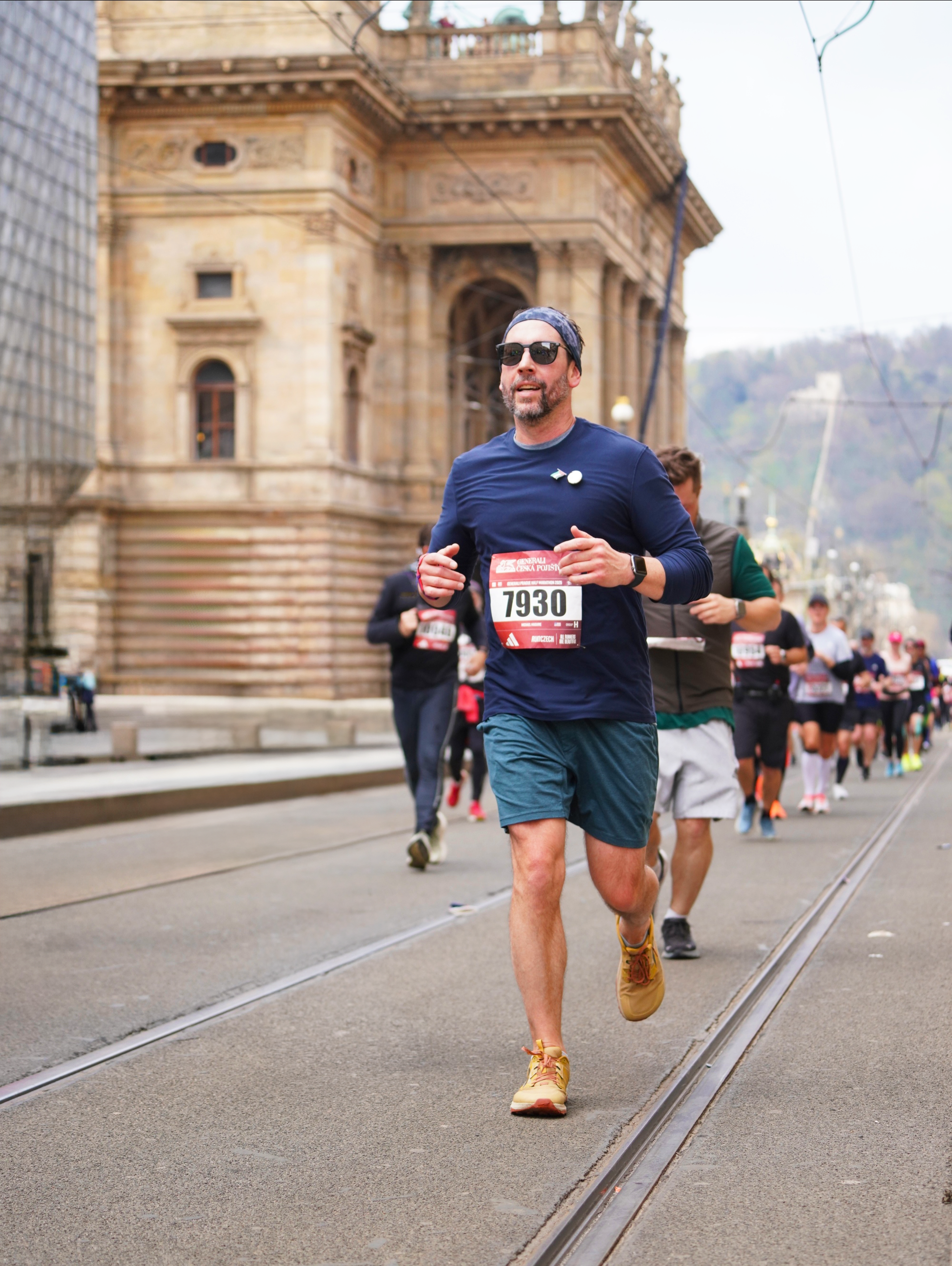
Once we arrived we had a couple days to rest and acclimate to the time change. We did some sight seeing and a 5 mile run three days before the race. We also got an Airbnb that had a dry sauna in it which I also want to mention is an absolute game changer. We hit the sauna after the 5 mile run and all the tension just melted out of our bodies. When the day of the race finally came I felt fantastic. There is so much energy in the air it’s infectious. The streets are lined with people cheering you on and little kids giving you hi fives. Bands on the corner every few miles playing all different types of music to keep you pumped up, along with water stations where you can just grab a cup of water and an orange slice or chunk of banana as you run by. Plus we had packed some of those Gu electrolyte chews in our waist packs. To my utter astonishment I hit 10 miles and actually picked up the pace for my last 3. I even started to feel sad when the signs began to pop up indicating that there were only 2 miles left. Even writing this now I’m reminded of how overwhelmed with excitement I had felt to have been a part of that, and to know how much I had put into achieving that moment. I totally get that not everyone needs to seek out challenges in their life, or do something to remind themselves of what they’re actually capable of, but I also know that there are people out there who know exactly what I’m talking about. And maybe even a few people who want to find out.
As always, feel free to reach out with questions or comments! Thanks for reading!